As the unit title suggests, our next set of class sessions takes a chronological tour through some major American intellectual movements, beginning with New England’s own transcendentalism. The Metaphysical Club will be reading and discussing Part Four, and you should be thinking about your own “big idea” for the final paper.
 Tues 3/25 Transcendentalism, Romanticism. Discussion leaders: Robert K, Oliver H. Reading: Henry David Thoreau, Walden (entire book, but especially Economy, Where I Lived and What I Lived For, Higher Laws, and Conclusion).
Thurs 3/27 Pragmatism. Discussion leaders: Jak K, Alex R. Background reading: Pragmatism (Stanford Encyclopedia of Philosophy). Reading: William James, “A New Name for Some Old Ways of Thinking” Pragmatism Lecture II: read at OpenLibrary, pp. 43-81, or here’s a 12-page PDF of the same text. For class discussion, think: why would YOU need this theory; what is it “good for” in your own intellectual work?
 Journal Prompt #6 – due Thurs 3/27 Write a 350+ word journal response addressing the evolution of American thought from Thoreau to James, and your take on the major 19th century intellectual movements we’ve read about in the course so far, including abolitionism and feminism (you might return to the Popular Lecture essay to refresh your memory on the intellectual world of antebellum America). If you are participating in the Metaphysical Club book group, has reading that book alongside these original works enabled you to connect the ideas, movements and people together better?
Tues 4/1 The Modern Temper. Reading: Daniel Bell, “Modernism Mummified” (PDF) and peruse the “American Modern” exhibit from MOMA. Choose your “Big Idea” by this date.
Thurs 4/3 The Self and Society. Discussion leaders: Tim S, Ross R. Reading: Thoreau, “Civil Disobedience” (if your edition of Walden does not contain it, you can read it online here); King, “Letter from Birmingham Jail,” MLK/Malcolm X book pp. 74-90.
Journal Prompt #7 – due Thurs 4/3 Write a 350+ word journal response to our recent readings on modernity, modernism, and the self in modern society. With whom do you most identify? Which thinkers or movements do you think have been most influential or important in the 20th century?
Between 4/1 and 4/9 – meet with Dr. Hangen to discuss your “Big Idea” project
Tues 4/8 American Thought from the Bench. Discussion leaders: Tim E, Jessica T. Reading: Pick EITHER Whitney v. CA (1927) – About the Case, Full Text
OR
Korematsu v. US (1944) – About the Case, Full Text
(Aside: here’s a 2009 discussion of lawyers considering/arguing which cases I should have you read)
Thurs 4/10 The 1960s Watershed. Metaphysical Club, please make sure you post by this date. Reading: to get a sense of the voice of protest and proclamation in the 1950s/1960s, the bold yawp of a new generation, I’d like everyone to read Alan Ginsberg’s 1956 free verse poem, “Howl†(In class we will also listen to this recording of Ginsberg reading it).
Then, I’m giving you a short list of other manifestos (and consider what IS a manifesto, anyway? – and why did this era see so many of them?) and I hope that you’ll read at least 2-3 of them if not all. Think about where and why these statements were written, published, and publicized. Is there a unifying theme? Is there an identifiable intellectual movement (or at least mood/temper) of the decade?
Young Americans for Freedom, Sharon Statement (1960)
Students for a Democratic Society, Port Huron Statement (1962)
“No More Miss America!” (1968)
Black Woman’s Manifesto (1970)
Poet Power (1968)
Indians of All Nations, Proclamation to the Great White Father and his People (1969)
James Foreman/ SNCC, Black Manifesto (1969)
Sex and Caste: A Kind of Memo (1965)
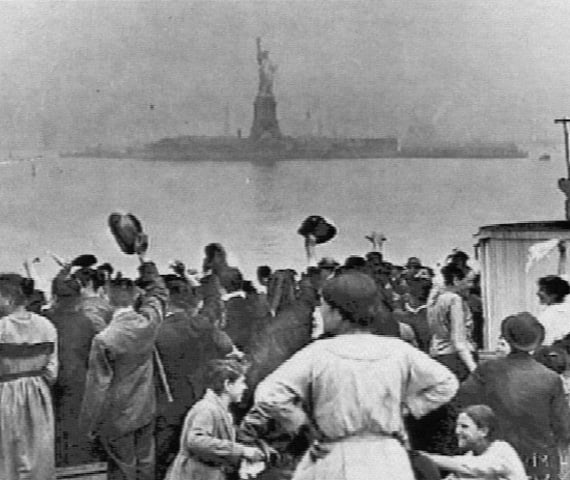 It is focused on the “big ideas†of cultural pluralism and the “melting pot†that arose in the context of the huge wave of (mainly) European immigrants during the era of Ellis Island from the 1890s to the 1920s. Although we are confining ourselves to debates over immigration and assimilation that took place a century ago, I am sure you will see the relevance to our current moment of unsettled public debate over immigration and belonging.