Archive for February, 2011

Deep Unit: America, 1930-1945

by Dr. H - February 26th, 2011

Over the next 2 weeks we will be looking at the period from 1930 to 1945. On Wednesday we’ll finish up the 1920s with a discussion based on your worksheet from Friday (which you have no doubt worked on over the weekend). If you were writing the chapter on the 1920s, who would you put at the beginning? Who, for you, exemplifies the spirit of that decade? As you researched the people on the list I gave you (the list is below), what were some new things you learned? We will also go over the stock market crash and the start of the Great Depression (Chapters 24 and 25). I’ll hand back your Document Duels #4 and #5 and share my thoughts on how those weekly assignments are going. I will introduce the Primary Source Project assignment.

On Wednesday of this week, please bring the FTR book to class, because we’ll be starting the Primary Source Project, a paper that compares 2 primary source documents and uses them to build an evidence-based historical argument. The guidelines are also posted under the Assignments tab.
World War I Over There and Over Here

by Dr. H - February 23rd, 2011

Links for today’s class:

Over There (vintage audio recording of the war’s most popular song)

Winsor McCay’s 1918 animated mini-documentary film “Sinking of the Lusitania“

Sprint Unit: 1900-1929

by Dr. H - February 22nd, 2011

In class on Friday, I called this a “lightning round” – we’re covering some quick ground this week to bring us up to the 1930s. There’s a lot more reading this week, and for that reason we’re only hitting the highlights, main points, and big concepts.

On Friday 18th we discussed the Progressive Era and did an in-class exercise to think like Progressives. On your own, study what Progressives did (and did NOT) achieve, now that you know what their goals and methods were. How successful were they? What were some of their legacies? What happened to the Progressive movement, how and why did it end?

On Wednesday 23rd, we will look at World War I. The United States reluctantly (and belatedly) entered the war, sending some 2 million soldiers and nurses overseas, and the war had dramatic political and cultural consequences on the American homefront even though our participation in the conflict was relatively short-lived. Once again we will have an in-class workshop, so read Chapter 23 in preparation for that.

On Friday 25th, we look at the 1920s, sometimes called the “Jazz Age” (and why is that?). Chapter 24 opens with a vignette about the media-savvy California Pentecostal evangelist Sister Aimee McPherson. By coincidence, she was one of the subjects of my research and I have had the good fortune to be part of a documentary film about her, so we will screen a few clips in class. After reading the rest of the chapter, why do you think the editors chose her to represent the “New Era”? Who else might you choose? Our in-class workshop will showcase some of the people that made the 1920s so transformative–and we’ll end class with a huge, traumatic crash in the stock market as the roaring twenties came to a screeching halt in October 1929.

Preparing for Exam #1

by Dr. H - February 14th, 2011

Our first exam will be Wednesday, February 16th. It will cover the material in Chapters 17-21 of Experience History. It will be an open-book test. You can bring and use both the Experience History textbook and the For the Record reader (but no notes).

The format will include multiple-choice questions, a timeline, short identifications and an essay question that will ask you to use one or more documents in the FTR reader.

Do not assume that because it is open book that you will not need to study. Open-book exams are considerably harder than closed-book ones, I assure you. I am not providing a “study guide”; let the book be your guide – you are responsible for anything that is covered in the textbook. You should study the textbook thoroughly, including the review & timelines at the end of each chapter. Remember that you can also take advantage of the free self-tests, flash cards, quizzes and other review materials at the Norton StudySpace, and using the resources in their Chapters 18-23 will allow you to study the material that this first unit has covered.

Urban Machines

by Dr. H - February 9th, 2011

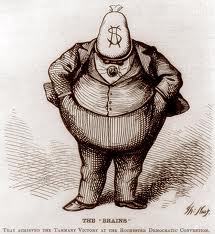
Thomas Nast, “Boss Tweed”

Links for today’s class:

NY Tenement Museum

William Grimes, “Your Tired, Your Poor, and Their Food,” New York Times 8/26/2010

Visions of America

by Dr. H - February 7th, 2011

Two videos for our consideration today:

Super Bowl XLV “The Journey” (pirated; hopefully the link will stay live today)

SchoolhouseRock, “Great American Melting Pot“

Friday’s Class, Mapping Labor Conflicts in the Gilded Age

by Dr. H - February 4th, 2011

Click on any marker to see a short explanation of a Gilded-Age labor uprising, strike, or riot.

Gilded Age Industrial Conflicts on Google Maps

View Gilded Age Industrial Conflict in a larger map