The last exam (Chapters 27-29) will take place on May 12th from 8:30 – 11:30 am in our regular classroom. It will be the equivalent of the other three exams. It is not designed to fill the full three hours, but you should expect it to take longer to complete than our other exams. As before, you may bring one 8.5×11†sheet of notes.
Reminder – Monday, Oct 14: No class, Columbus Day holiday
*Please note* – this unit’s classroom Powerpoint slides are available under the “Slideshows” tab above; they make great study aids!
Online quiz #2 is now open on Blackboard under “Quizzes.” You can take it up to three times before it closes on Friday, Oct 18th at 8:30 am, so please make sure you do that this week!
Wednesday, Oct 16: Workshop Day – New Deal Legacy. Reading: ACH 23: 711-722. Bring the ACH book to class with you for the workshop. Laptops will be helpful too, although everyone doesn’t have to bring their own.
Friday, Sept 27 will be our Exam #1, drawing from the readings in Chapters 18-19 and our workshop class sessions during this first unit of the course. Remember – your lowest exam gets dropped, so if you miss this one just let it go, as there are no make-ups on exams.
What to bring to the exam: you may bring ONE 8.5×11″ sheet of paper and it can have anything printed or written on it (both sides OK). Also bring two pens or pencils (good to have an extra, in case). The exam will be closed-book, closed-note except for the one piece of paper.
Also – please make sure you take the online quiz (Blackboard –> Quizzes) before Friday’s class. Once it closes, it’s gone, and none of the quizzes gets dropped: they are all required.
Monday 5/6 is our last day of class (Reading is ACH Ch 31 pp. 962-974) – History Now Projects are due IN CLASS. They can also be submitted before the deadline, in my History Office mailbox, if you prefer. Also due on Monday 5/6 is any remaining work, including the extra credit (see below).
Need Extra Credit? You can visit the “From Kennedy to Kent State” exhibit at the Worcester Art Museum and write about the exhibit and/or a particular photograph within it, connecting it to our current unit on the 1960s. Your Worcester ID gets you free admission, so be sure to bring it with you when you go. Same length as a SkillBuilder, and up to 5 points extra credit. Submit by email or bring to class on the 6th.
Update: Unit 4 slides are now posted under the “Slides” tab above to help you study for the 4th exam.
Final Exam Information: Download the Study Guide here. You may bring two things to the exam: a filled 3×5 card, as with all the other exams AND the Fernlund reader, Documents for America’s History. You have from 8:30 to 11:30 to take the exam, although it is weighted the same as all the others ones we’ve taken. You will get your History Now Project grade at the exam (or by email if I don’t see you there).
8:30 class – your exam is Friday 5/10 at 8:30
9:30 class – your exam is Monday 5/13 at 8:30
Thanks for a great term!
Tagged: Spr13 Filed under: News, Study Strategies :: Comments Off on (Spring 2013) End of Term Reminders
Reminder – please bring the Fernlund book AND your laptop to our workshop on Wednesday March 13th!
Exam #2 will be on Friday during class. Download the study guide here if you didn’t get one in class yet. Remember that the online quiz closes at 9:00 am on Friday morning, so make sure you’ve taken it at least once by then.
Over the next 2 weeks, we’ll go from the Roaring Twenties to the Great Depression to the New Deal and slow economic recovery. What happened? Why? And with what effect? What kinds of sources do historians have to help us understand the causes and impact of the financial crash? Where do historians disagree about the Depression and the 1930s? What does the Great Depression have to tell us about the Great Recession?
Reminder – keep working on your Primary Source paper due Friday. I do have office hours this week – stop in with a draft & your Fernlund book in hand if you want help. I have also let the Writing Center know that some of my students might be stopping in this week and sent them a copy of the assignment and handouts (location: Sullivan 306).
We screened and discussed this documentary clip in class (excerpt from PBS American Experience New York)
Wed 3/6 – The First New Deal (1933-1935). Reading ACH Ch 23 p. 700-707.
Clips for viewing and discussion:
FDR’s First Inaugural (3 March 1933)
“Remember My Forgotten Man” from Gold Diggers of 1933
Fri 3/8 – Second New Deal (1935-1938). Reading ACH Ch 23 p. 707-711. Primary Source Paper due. On this day, the online quiz (on ACH Ch 20) will open, and remain open until Friday March 15 at 9:00 am. You can take it up to three times during that week. Update: snow day. Paper deadline extended to Monday.
Mon 3/11 – Impact of the New Deal. Reading ACH Ch 23 p. 711-723. Final printed Primary Source paper due in class if you haven’t emailed it to me already.
Wed 3/13 – Workshop Day on the 1930s. Bring Fernlund Documents AND YOUR LAPTOP to class, and review ACH Ch 23.
Fri 3/15 – Exam #2 in class. Online quiz closes at 9:00 am. NO SKILLBUILDER DUE.
Spring Break – Week of March 18 – have a wonderful vacation!
Thank you, everyone, for making my early mornings so enjoyable! I hope you learned a lot this term – both about US history itself, and about the process by which it gets made and why it’s so fascinating & important.
Please take note of these details to finish up the term well:
Mon Dec 7th – Turn in your History Now projects in class. The online portion of the last exam will go live by 9:00 am. You have until Dec 12th at 8:00 am to take it up to 3 times. It is 20 questions, worth 12 points total. Everyone needs to take this one, because ALL of the online tests are required and none gets dropped.
The terms and concepts on the online test are from Chapters 13 and 14:
New Right
Reaganomics
Deregulation (in the context of the Reagan Era)
SDI
Iran-Contra
Berlin Wall’s fall
NAFTA
1986 Immigration Act
Clinton’s impeachment
2000 Election
Al Qaeda
Bush Doctrine
War in Iran & Afghanistan
Patriot Act
SB 1070
Wed Dec 12th – online test closes at 8:00 am. The written portion will be given in our classroom starting at 8:30 am, and I will also have the History Now evaluations & grades for you then. The lowest exam is dropped, so you do not have to take the written portion if you are happy with your other exam grades.
Updated: The written exam will be based on our discussions in class about race, immigration and identity since the 1980s. Please study the textbook sections for this unit as listed in the syllabus: 13.1, 13.2, 13.4, and 14.3. Be prepared to answer questions or write about: Reaganomics and its consequences, globalization, and changes in immigration and racial/ethnic diversity. There will likely be a question about what you learned about recent history from doing the “History Now” project, similar to what you wrote on in class. It is not designed to take 3 hours – plan on about 50-70 minutes to take the exam.
Thanks, and have a great holiday!
Tagged: Fall12 Filed under: In Class, Study Strategies :: Comments Off on (Fall 2012) Thanks for a Great Term! Final Details…
Reminder, if you’re reading this on Friday – you have until just before midnight tonight to take the last online quiz (on Ch 31). Go to Blackboard under “Quizzes.”
Our last exam will cover both Units 5 and 6 (Vietnam and 9/11). It will be Wednesday, May 9th at 8:30 am in our regular classroom. Study EH Ch 30 and 32. To the exam, you may bring one single 8.5×11″ sheet of paper with anything you desire on it (front and back).
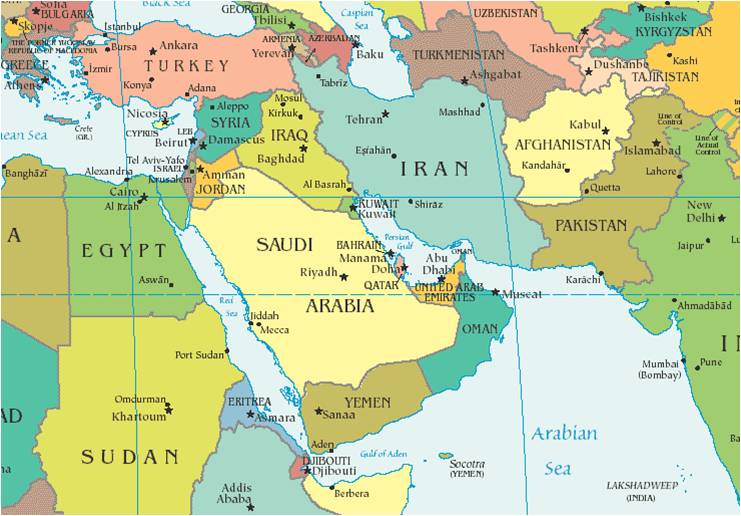
Here is a study guide for the exam (download as PDF). And here’s the map we looked at in Friday’s class –
Tagged: Spr12 Filed under: News, Study Strategies :: Comments Off on Instructions & Study Guide for Exam #5
Hello all – I’m very sorry, but I have to miss class tomorrow morning, Wed 4/4, so class that day is cancelled. We will still have our exam on Friday 4/6 and it will be OPEN BOOK on Chapter 28, “The Suburban Era.” The review questions (in yellow) throughout the chapter, as well as the chart on p. 805 will help you as you prepare. You should also be able to write about a TV clip of your choice from the Workshop day – all the links to those are up on the course website still (see below).
Fri 3/9 – a peer review day for drafts of your primary source paper. Bring a printed draft of your paper to class, whatever you have, at whatever stage it’s in. For the full guidelines on this project, see the PS Paper tab above.
Mon 3/12 – Popular Culture in the 1930s. Reading EH Ch 25 706-714