Archive for February, 2013

Harlem Renaissance Resources

by Dr. H - February 27th, 2013

Today for our workshop, you’ll work to find a brief (but historically accurate) group answer to your assigned question, and then present your findings to the rest of the class. Within your group you should have enough people to fill at least these roles, although the whole group should work together on the research:

A scribe (completes the worksheet)
A spokesperson (reports to the rest of the class – 1-2 minutes MAX)
A fact-checker (assesses the quality/reliability of the sources your group uses)
Researchers (locating and synthesizing information)

You can use additional resources if you want, but steer clear of Wikipedia, Infoplease, Ask.com, YahooAnswers and similar sites.

Your group should be ready to report at 5 after the hour!

Online Resources

Early Jazz or 1920s Jazz (PBS Culture Shock)
American Jazz Culture in the Early 1920s (University of Minnesota Duluth)
Harlem History – Columbia University
Harlem: A History in Pictures – New York Metro
Harlem Renaissance and the Flowering of Creativity (Library of Congress)
The Jazz Age and the Harlem Renaissance (Encyclopedia Britannica)
Harlem Renaissance (John Carroll University, best view in Internet Explorer)
Digital Harlem (University of Sydney)
The Cotton Club of Harlem (Encyclopedia Britannica)
The Cotton Club (PBS)
Marcus Garvey, UNIA Papers (UCLA)
Marcus Garvey (National Humanities Center)
“After 200 Years, 125th is Still Harlem’s Main Street” (Columbia Spectator)
Harlem 1900-1940 (Schomburg Center)

And from the “Harlem’s Still the Symbolic Heart of American Black Culture” department –

“Long Before the Harlem Shake…” (NPR)
and
“Fader Explains: The Harlem Shake” (Fader)
“The Harlem Shake is Dead, Long Live the Harlem Shake” (Time)

The 1920s (and footnote corrections)

by Dr. H - February 26th, 2013

This week we’re talking about the 1920s: an introduction to modernity and modernism on Monday based on the first part of Chapter 22, and on Wednesday an in-class workshop on the Harlem Renaissance (read ACH Ch 22 673-687) – please bring laptops on Wednesday 2/27. If you want a sneak preview of online resources, check this page of Harlem Renaissance links.

Reminder: be working on a draft of your Primary Source paper, using any two documents of your choice from the reader. The draft is due as a printed paper in class on Friday 3/1.

For your MDQ (Monday Daily Question) this week you practiced writing identifications and also making footnotes. In checking my advice handout I found I had made a mistake myself on the handout (believe me, I know it’s hard to get footnotes right!).

The correct form for citing a document in Fernlund’s book is (using Document 20-8 as an example):

3. Booker T. Washington, “Atlanta Exposition Address,” Up from Slavery: An Autobiography (1900), in Documents for America’s History: Volume 2: Since 1865, ed. Kevin J. Fernlund (Boston and New York: Bedford/St. Martin’s, 2011), 142.

Start of Unit 2 – Week of 2/18

by Dr. H - February 16th, 2013

Reminder: No class on Monday, Feb 18th (President’s Day)

Remember the Maine ButtonUnit Overview: This week we begin unit #2, on the US from 1890-1940. Our main chapters will be 22 and 23, with a short 2-day overview of Chapter 21. This unit’s online quiz will cover Chapter 20 and will be open March 8-15. Also during this unit, you will be writing a longer (5-page) essay based on two primary sources of your choosing (see the tab above for guidelines). A draft of the paper is due on March 1 and the final version due on March 8. The unit exam will be on Friday, March 15.

Wed 2/20 Imperialism and Foreign Policy – Reading ACH Ch 21 pp. 629-641 (slides posted below)

Fri 2/22 World War I – Reading ACH Ch 21 pp. 641-658. SkillBuilder #4 due by the time class starts – pick a SkillBuilder document from Chapter 20 or 21. Also – by this date, choose the two documents you plan to write about for the Primary Source Project.

Questions to think about as you read this week:
How and why did the US become an “emerging world power” at the start of the 20th century?
What were the international and domestic consequences of American military, cultural and economic expansion?
Who supported and who opposed American imperialism?
How did the nation move from neutrality to participation in World War I?
What kinds of sources and documents do we have to help us understand this era?

Wednesday’s slides were rather text-heavy, so I’m posting for easier notetaking – click fullscreen icon to enlarge

112 Imperialism.Spr13

No Class Monday 2/11

by Dr. H - February 11th, 2013

Due to ongoing snow removal, there is no class today and campus is closed. Materials are posted below from last Friday’s “online class” including this downloadable study guide for the in-class exam on Friday 2/15.

On Wednesday 2/13 we will have a workshop during class based on Chapter 18. Please read the Henretta ACH chapter 18 ahead of time, and bring the Fernlund reader Documents for America’s History with you to class on Wednesday.

Thanks, stay safe! See you Wednesday.

Recommended viewing this week, related to Chapter 18 –

Watch Women of PROHIBITION: Frances Willard & Mary Hanchett Hunt on PBS. See more from Prohibition.

“Online Friday” 2/8 (thanks, Nemo)

by Dr. H - February 8th, 2013

Since when did we begin naming snowstorms? Anyway. We don’t have class today; this is the “online version” instead. Stay safe and warm today!

Some quick reminders and news:

  • Please remember that the online quiz is open until 9:00 am Friday 2/8.
  • Your SkillBuilder is due Friday morning on the regular schedule, by the start of your classtime. Send it as an email attachment (.doc, .docx, or .rtf) with your LAST NAME as the start of the filename. Example: Hangen.Skillbuilder3
  • Next Friday will be in-class exam #1 – click here to download the study guide. You may bring with you to the exam ONE 3×5 index card with anything you want on it.
  • The reading for Monday is ACH Chapter 18 (the entire chapter – read for main ideas, not for the little details)
  • Got questions? Leave a comment, or email me. See you Monday!

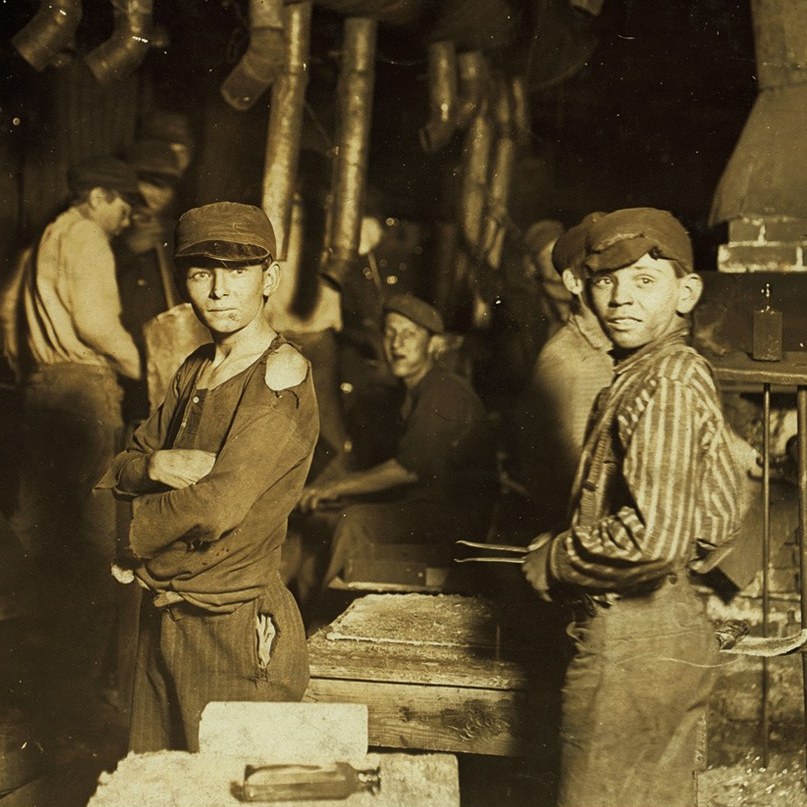
Today’s reading was ACH Ch 17, p. 528-537 about labor organizing. Begin by thinking about some of the wretched conditions that late 19th century workers experienced (click on any of the pictures for more details).

Child Labor

Manuel, the young shrimp picker, 5 years old (Biloxi, Mississippi)

Dangerous, Dirty Workplaces

A view of Ewen Breaker (PA) Coal Co.

No Compensation for Workplace Injury

Harry McShane.

Unregulated Waste Disposal
Scavenger. Location: Chicopee Falls, Massachusetts
Poor Quality Housing

Housing conditions at Lynchburg (VA) Cotton Mills

(All of these photographs were taken by Lewis Hine, in his work documenting American workers for the National Child Labor Committee. Click here to see more of Hine’s work)

Between 1870 and 1900, there were a number of movements and organizations that sought to unite the “producing classes” – which included both wage laborers and farmers, since both groups saw themselves “at the mercy of large corporations” (Henretta 529). Such movements include:

  • Grange (founded 1867) – cooperative rural aid society that provided meeting halls, banks, insurance, grain storage, and farm equipment. Supported paper currency (Greenbacks) and allied with labor in some parts of the country to form the Greenback-Labor political party.
  • Knights of Labor, which started as a fraternal society for garment workers and expanded to be a large and politically active organization that included both men and women, skilled and unskilled, and black and white. Their motto was “An Injury to One Is the Concern of All.” Their leader was Terence Powderly and they were at the height of their influence in 1886 (due in part to the tireless work of Leonora Barry) when the Haymarket Riot decimated their public image and their membership numbers plummeted. We do have the KL to thank for Labor Day, though.
  • Farmers’ Alliances, which took up many of the same issues that Grange and Greenbackers had and tried to organize a system of cooperative exchanges for crops and farm products, and helped pass the Hatch Act and the legislation that formed the Interstate Commerce Commission (ICC).
  • The American Federation of Labor, led for many years by Samuel Gompers of the Cigar-Makers Union, which took a very different strategy and focused more narrowly on negotiating wages, benefits and working conditions directly with employers.

Question for reflection: Who–or what kinds of workers–were included within and who might have been left out of these labor organizations. Who benefited, and who didn’t, and why?

Business, Work, and Immigration – Week of 2/4

by Dr. H - February 3rd, 2013

art_17_03_child_labor.CrpdThis week, we’ll be reading Chapter 17 and exploring the history of business, industrialization, labor unions, and immigration. Those are big forces, so we will try to understand them not only as broad collective movements and trends, but also at the level of the individual, the family, and the community. Also, don’t forget to take the online quiz (on Ch 19) by 9:00 am Friday 2/8!

Mon 2/4 – Big Business Getting Bigger. We will have our first Monday Daily Question (MDQ) right at the start of class. Come having read ACH Ch 17 p. 506 – 521 (the syllabus says 522 but it ends on 521). The reading is once again posted on Blackboard in case there’s still someone without a 5th edition. Click here for a link to Harvard’s trade card exhibit I mentioned in class, and here are Monday’s slides (click the fullscreen icon to enlarge):

112.7 BigBusinessGildedAge.4Feb13

Wed 2/6 – Immigrants, East and West. Reading = ACH Ch 17 p. 533 – 528. Who was coming to the US as an immigrant in the late 19th century? What were their prospects as new Americans? Who could, and who couldn’t, become a US citizen? Where did new arrivals live and find work?

Links we’ll use in class on Wednesday:
The Great American Melting Pot
Photos of New York’s immigrant neighborhoods from “How the Other Half Lives” (Jacob Riis/ UVA Xroads)
Immigration Explorer Map (New York Times)
The Chinese in California 1850-1925 (Library of Congress)
Ellis Island Museum and Foundation

Fri 2/8 – Labor Gets Organized. Reading = ACH Ch 17 p. 528 – 537. SkillBuilder #3 is due by the start of class. Online Quiz #1 will close at 9:00 am. Update: if the weather is bad on Friday and school is cancelled, no worries – just email your paper, and make sure you’ve taken the online quiz. I will send out or post the slides & notes from that day if we don’t have class.