Read the syllabus
Consider your personal goals for this class and your individual “track†within the course
Read EH Table of Contents, Introduction and Ch 17. Understand the multiple meanings for the word “RECONSTRUCTIONâ€
Write your first SkillBuilder, on the “Wet With Blood” website – Guidelines here (PDF) – it’s due in or before class on Friday
Prepare to vote on the deep units & bring your ballot to class
Tagged: Spr12 Filed under: Digital History, In Class :: Comments Off on For Friday 1/20: Was the US Reconstructed?
This website serves as the hub for Tona Hangen’s sections of US History II (HI 112), the US Since 1877. In Spring 2012 I will teach one section, on MWF at 10:30 am. The course number is HI 112-11 or HI 112-H1 if you’re taking it for honors credit.
Our textbook is James Davidson, et al., Experience History: Interpreting America’s Past, ISBN 978-0077368326. There is one copy of the book on reserve at the library circulation desk, so in case you can’t get your copy before the course starts, you can check it out on 2-hour reserve.
From this site, you can download the syllabus or access it online, stay up to date with course news and any changes, see the guidelines for the course papers and projects, and follow links to my recommended history and writing resources on the web. You can also add the course’s Google calendar to your own; just click on the “About & Course Calendar” tab above.
This site is a blog, meaning it updates frequently and you should bookmark it or subscribe to it using an RSS feed reader (such as Google Reader). Please check it often or make sure that you subscribe to its updates to stay on top of our coursework. I leave up the previous semesters’ information as an archive for my past students. You can safely ignore any post that’s tagged at the bottom with “Fall11” or “Spring11” or “Fall2010,” since your posts will be tagged “Spr12.”
If you have questions about the course before we meet in person on Wednesday, January 18th, please feel free to email me, at thangen (at) worcester.edu
Tagged: Spr12 Filed under: News :: Comments Off on Welcome Spring 2012 students!
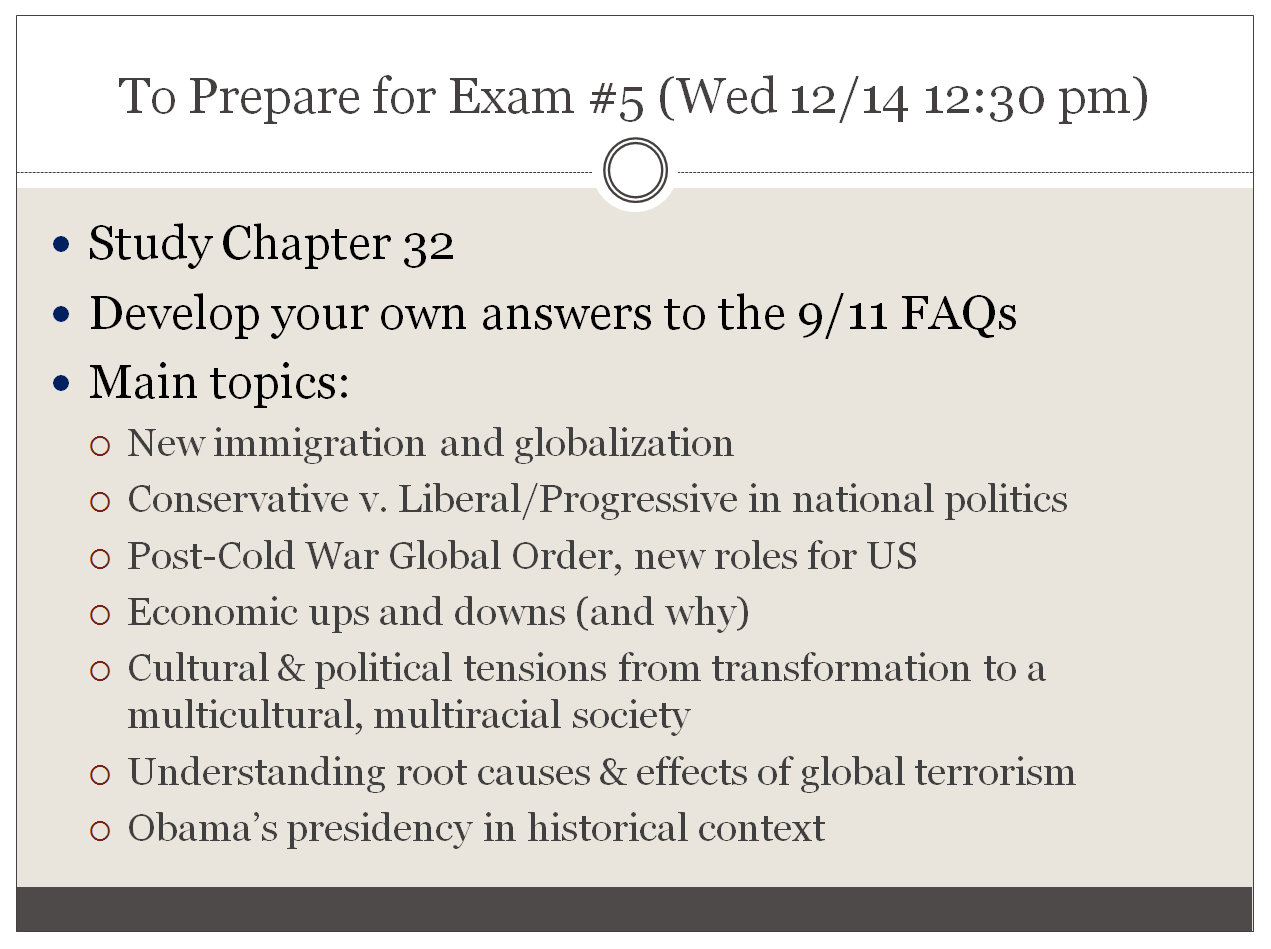
Our final exam will be on Wednesday, December 14th 12:30 – 3:30 pm in the LRC-327 classroom.
How to prepare:
What to bring:
You may bring ONE sheet of 8.5×11 paper with notes (or anything) on it. You can use the front and back; put as much or as little on it as you like.
Your “History Now†project is due in or before class. No electronic submissions, it must be turned in as a paper packet.
Reading for Friday’s class is EH 32:923-929 and Barack Obama’s speech given on December 6, 2011 in Osawatomie, Kansas. Why did he give it there? What parts of US history was he deliberately invoking, and why? How would you set this speech into historical context, given what you now know about US History since 1877 and what you now know how about how historians approach historical texts?
These will be the basis of our class discussion next Wednesday. You’ll be working on answering them to your satisfaction and so will I, and let’s bring our thoughts together next Wednesday to build a collective framework for understanding this complex event and its many repercussions in our nation and world today.
Questions Re: 9/11/2001
Why did the hijackers choose the specific date of 9/11/2001?
Why were the World Trade Center towers the target? What was their importance or significance?
What were the motives of this attack? Why did they attack us?
What did the hijackers think was going to happen?
Where was Flight 93 headed, what was its intended destination?
What kind of security breaches occurred at the related airports that allowed the hijackers and their weapons on board the aircraft?
Why did groups that we supported in the 1980s and 1990s later turn into terrorist groups so hostile and determined to hurt our country?
Why did the US give Arabs weapons in the 1990s?
Were there any signs this was going to happen?
If the government knew what the terrorists were planning, was there really a conspiracy or did the attackers just get lucky?
Tagged: Fall11 Filed under: In Class :: Comments Off on Your 9/11 Questions
Wednesday’s class on 12/7 will be focused on addressing your questions, curiosity and knowledge gaps about 9/11/2001. Remember to keep our Unit 5 model in mind. Start with the event itself: what happened, and what did it mean? Then work either forwards (legacy, consequences, short and long-term effects) or backwards (what do you need to know in order for this event to make sense to you?).
Choose your own reading from the list below; these include resources, articles, videos, curriculum lesson plans, and other material from 9/11/2001 and the 10-year commemoration earlier this fall. Take a close look through at least one of these links, and read more if you feel you need more.
In the last unit of the course, we will jump to the post-Cold War era (approx since 1989). There will be an online quiz opening on Tuesday, November 29th until Sunday, December 4th (on Chapter 30 and 31). Our in-class work will deal mainly with material in Chapter 32.
Wed 11/30: Globalization and the United States – read EH 32:900-917
Fri 12/2: All about 9/11/2001 – read EH 32:917-923. Skill Builder #6, the last one, is due in class
Mon 12/5: A workshop day, focusing on the “History Now” project. No assigned reading. If you revised your Primary Source paper, the revision is due in class (no electronic submissions).
Wed 12/7: Your FAQs Answered. Reading: 9/11 materials of your choice, see the list in the entry for Friday 12/2
Fri 12/9: History Today and Tomorrow. Reading: EH 32:923-929 and one additional short reading, TBA. Your “History Now” project is due in or before class. No electronic submissions, it must be turned in as a paper packet.
Last Exam: The 5th exam will be Wednesday 12/14 at 12:30 pm in our classroom. It is the regular exam for Unit 5, not a comprehensive final.
Tagged: Fall11 Filed under: In Class :: Comments Off on Unit 5: America Today
Our Unit 4 exam will be on Monday, Nov 21. I am out of town presenting at a conference (the AAR in San Francisco) but Dr. Lisa Boehm from Urban Studies will be there in my place to give out and collect the exam. I hope everyone has a wonderful Thanksgiving break and I’ll see you on the other side of the turkey and pie.
On Friday in class, I wrote a list on the board of 11 reasons former Secretary of Defense Robert McNamara (whose resignation is covered in your book) thought — in retrospect — that the United States had blundered in Vietnam. Here is the list, and for you snorkelers/divers, you can read excerpts on Google Books from the original if you like. Think about whether you agree with this list and what evidence you can think of to support or refute McNamara’s statements.
We misjudged North Vietnamese and Viet Cong’s geopolitical intentions and exaggerated their dangers
We viewed South Vietnam in terms of our own experience instead of theirs
We underestimated the power of Vietnamese nationalism
We didn’t have enough trained advisors for Asia in positions of responsibility in the military and the State Department, and had too few well-informed senior diplomats
It was high-tech warfare v. low-tech people and failed to win their hearts and minds
Didn’t involve Congress and public debate enough
Didn’t retain popular support at home, were too secretive
We have no “God-given right to shape every nation in our image”
It was a unilateral action and all unilateral actions are doomed
Although the US is powerful and rich, it can’t solve every problem in every nation
It proved too hard to sustain a long-term effort and momentum over many different presidential administrations at the top levels of the military
My recommendations for studying: review Chapter 30 closely. Be able to identify, list or discuss events that happened during the Vietnam Era both in the US and in the region of Vietnam. Have a working understanding of how the conflict began, how it progressed, and how it ended. Be able to distinguish among anti-war organizations and talk about the rise & fall of a protest movement and some of its main events. Consider your notes from the M*A*S*H episode and what cultural productions like that program add to our historical understanding of the era. Re-read Theriault’s article and be prepared to discuss the contradictions and complexities of the Vietnam Memorial, and of the wall’s role in American public memory about the war.
Here are the slides from today’s lecture/discussion. Much of this same information is covered in greater depth in the reading assignment: EH Ch 28:794-804 and Ch 30:842-848, 865. Also, don’t forget to notice Veteran’s Day articles, events or commemorations that refer back to the Vietnam War – try to bring in something to share on Monday. Have a great holiday weekend!