by Dr. H - April 20th, 2011
Here’s the link to the class wiki: you will need to “Join This Wiki” which may ask for a username and password. (If you’ve ever used Wikispaces before, you can use the same username/password you’ve already made).
http://www.since1989.wikispaces.com
Remember to bring your textbooks and your laptops on Friday so we can work on this in our groups.
Tagged: Spr11
Filed under: Digital History, In Class :: Comments Off on The “Since 1989” Wiki
by Dr. H - April 9th, 2011
Our last unit will consider the U.S. since the 1970s. Our reading this week is Chapter 31. On Monday 4/11, we will have an in-class screening (of a 1978 M*A*S*H) episode and class discussion to wrap up the Vietnam and Watergate era. On Wednesday 4/13 and Friday 4/15, we will look at highlights and important concepts from 1974-1989.
Next week (Monday is a holiday, no class) will consider Chapter 32 and the end of the Cold War. We live in the “post-Cold War” era, what does that mean? When did it end, and how? What were the consequences both internationally and domestically?
During the week of April 25, you will take on a small project concerned with a recent event in American history. How do historians understand the recent past? What sources, questions, and materials can help students like yourselves understand events which happened in your own lifetimes? How do you set “history” into the context of your own life?
Tagged: Spr11
Filed under: In Class :: Comments Off on The Last Quarter-Century
by Dr. H - April 5th, 2011
I will be there by the end of class (I think!) so please take attendance on Wednesday 4/6. You can use that class period however you see fit – one big study session, small group work, individual study time, working on your Civil Rights Movement notes page…
I posted Monday’s slides under the “Slides” tab and also under “Resources” on the Course Blackboard.
Also, here is the blank handout from Monday with key terms from the Vietnam War era and from the Watergate scandal and trial, in case you didn’t pick one up in class.
Tagged: Spr11
Filed under: In Class, News, Study Strategies :: Comments Off on Group Study Day on Wed 4/6
by Dr. H - April 1st, 2011
There’s no class today, Friday 4/1 because of snow. I have posted the class lecture notes and slides that we would have used today under the “Resources” tab on the course Blackboard. See you Monday; the reading for Monday is Chapter 30.
Document Duels can be submitted via email or Digital Dropbox.
Just a heads-up – Next Wednesday, April 6th, I will be giving a talk on campus for a large group of Worcester Public High School students at 9 am. I cannot be in class for our whole hour because of that presentation, but I will plan to be there by 10:15 when class ends. My proposal is that you students come to class without me, and use the class period as a group study session (with attendance taken). I will be happy to address any questions on Monday the 4th also. See the previous post (below) for more information about how to prepare for the exam on Friday the 8th.
Tagged: Spr11
Filed under: In Class, News, Study Strategies :: Comments Off on Snow Day, Friday April 1
by Dr. H - March 31st, 2011
The exam next Friday, April 8th will cover Chapters 27-30, and will be closed-book but “open note” for the portion that covers the civil rights movement. I would like each of you to make notes about the civil rights movement, either in the form of a TIMELINE or in the form of a CONCEPT MAP. You can bring those notes to the exam, and you’ll staple it to your test when you turn it in (your notes will become part of your exam grade).
What you put on it is entirely up to you. You can make it as detailed or simple as you like: this study tool is to help you, so you should design it in whatever way works best for you. I am envisioning something that fits on 1-2 sheets of paper, there’s no need to get more elaborate than that.
Please note: Although it’s fine to collaborate with others while you study or work on your notes, each person needs to bring his or her own unique note sheet to the exam. Any 2 or more timelines or concept maps that are exactly the same as each other will receive no credit.
Tagged: Spr11
Filed under: Study Strategies :: Comments Off on Preparing for Exam #3
by Dr. H - March 26th, 2011

I’m calling this deep unit “The Long Sixties” because it covers more than just the decade from 1960-1970. We’ll be talking about social and political movements, foreign policy and overseas conflicts that don’t fit neatly into those years – starting in the 1950s and stretching into the 1970s. We are still feeling the domestic and international effects from the turbulence of this era.
The exam on this unit will be on Friday, April 8th, and will cover Chapters 27-30.
Topics in this unit include:
Cold War foreign policy
Cuban Missile Crisis and Foreign Affairs in the Kennedy Years
The Vietnam War
The African-American Civil Rights Movement
Other Civil Rights Movements: the Women’s movement/ Feminism, “Red Power,” and “Brown Power”
Decisions of the Warren Supreme Court
The Anti-War Movement, the Counterculture, and the New Left
The New Frontier (Kennedy’s domestic agenda)
The Great Society (Johnson’s domestic agenda)
The Liberal Consensus
Watergate
Image credit: Gilbert Mercier
Tagged: Spr11
Filed under: In Class :: Comments Off on The Long Sixties
by Dr. H - March 26th, 2011
Here’s the slides I used on Friday to explain the intricacies of footnotes.
If you need more help with how to make a footnote, or what “Chicago Style” is see Diana Hacker online, or the CMS Quick Guide. If you’re curious about why it’s called “Chicago Style,” well… I’ll just say it has nothing to do with pizza.
Tagged: Spr11
Filed under: FYI, In Class :: Comments Off on Footnotes – Slides, Advice
by Dr. H - March 14th, 2011
Enjoy your spring break!
When you get back, we’ll be doing another quick “sprint unit” on the politics and culture of the Cold War, 1945-1960 (Chapters 27 and 28). If you have time and inclination over the break you would do well to begin reading and studying those chapters.
It will be a busy week because Wednesday 3/23 will be a writing workshop day on the Primary Source Project. Please bring your working draft (outline or complete paper draft or whatever you have) to class that day as a printed paper.
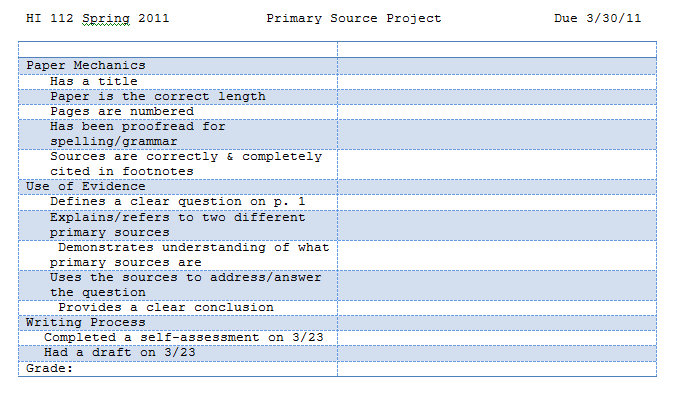
The final version is due on Wednesday, 3/30. I am happy to meet with anyone who would like writing help on the paper; please make use of my office hours or set up an appointment. To give you a checklist as you’re working on this project, the grading rubric looks like this:
Tagged: Spr11
Filed under: In Class :: Comments Off on Sprint Unit: Cold War America
by Dr. H - March 2nd, 2011
In looking at the schedule I had for the Primary Source Project, and since we had to miss a class on Monday, I am thinking that more time may be needed and so I’m going to stretch it out over the month of March instead of trying to fit it all in before the 2nd exam and the Spring break.
Please note that I revised the guidelines and the schedule of deadlines.
The new schedule is:
Mar 4Â Â Â Â Â Choose your documents and formulate your question (in-class workshop Wed Mar 2)
Mar 7Â Â Â Â Â Begin writing a draft of your paper
Mar 23Â Â Rough draft due in class for self and peer review (in-class workshop Wed 3/23)
Mar 30Â Â Final essay is due in class in hard copy (or uploaded by Digital Dropbox BEFORE class).
I will have a paper version of this assignment in class on Wed 3/2. Please still bring your FTR book, we will work on choosing documents and formulating questions.
Also on Wed 3/2 we will wrap up on the 1920s and discuss the Great Depression: its causes, impact, effects, meaning–leading up to the pivotal election of 1932.
Tagged: Spr11
Filed under: In Class :: Comments Off on Primary Source Project, Revised
by Dr. H - February 26th, 2011
Over the next 2 weeks we will be looking at the period from 1930 to 1945. On Wednesday we’ll finish up the 1920s with a discussion based on your worksheet from Friday (which you have no doubt worked on over the weekend). If you were writing the chapter on the 1920s, who would you put at the beginning? Who, for you, exemplifies the spirit of that decade? As you researched the people on the list I gave you (the list is below), what were some new things you learned? We will also go over the stock market crash and the start of the Great Depression (Chapters 24 and 25). I’ll hand back your Document Duels #4 and #5 and share my thoughts on how those weekly assignments are going. I will introduce the Primary Source Project assignment.
On Wednesday of this week, please bring the FTR book to class, because we’ll be starting the Primary Source Project, a paper that compares 2 primary source documents and uses them to build an evidence-based historical argument. The guidelines are also posted under the Assignments tab.
Tagged: Spr11
Filed under: In Class :: Comments Off on Deep Unit: America, 1930-1945
