World War I Over There and Over Here
by Dr. H - February 23rd, 2011
Links for today’s class:
Over There (vintage audio recording of the war’s most popular song)
Winsor McCay’s 1918 animated mini-documentary film “Sinking of the Lusitania“
Links for today’s class:
Over There (vintage audio recording of the war’s most popular song)
Winsor McCay’s 1918 animated mini-documentary film “Sinking of the Lusitania“
In class on Friday, I called this a “lightning round” – we’re covering some quick ground this week to bring us up to the 1930s. There’s a lot more reading this week, and for that reason we’re only hitting the highlights, main points, and big concepts.
On Friday 18th we discussed the Progressive Era and did an in-class exercise to think like Progressives. On your own, study what Progressives did (and did NOT) achieve, now that you know what their goals and methods were. How successful were they? What were some of their legacies? What happened to the Progressive movement, how and why did it end?
On Wednesday 23rd, we will look at World War I. The United States reluctantly (and belatedly) entered the war, sending some 2 million soldiers and nurses overseas, and the war had dramatic political and cultural consequences on the American homefront even though our participation in the conflict was relatively short-lived. Once again we will have an in-class workshop, so read Chapter 23 in preparation for that.
On Friday 25th, we look at the 1920s, sometimes called the “Jazz Age” (and why is that?). Chapter 24 opens with a vignette about the media-savvy California Pentecostal evangelist Sister Aimee McPherson. By coincidence, she was one of the subjects of my research and I have had the good fortune to be part of a documentary film about her, so we will screen a few clips in class. After reading the rest of the chapter, why do you think the editors chose her to represent the “New Era”? Who else might you choose? Our in-class workshop will showcase some of the people that made the 1920s so transformative–and we’ll end class with a huge, traumatic crash in the stock market as the roaring twenties came to a screeching halt in October 1929.
Our first exam will be Wednesday, February 16th. It will cover the material in Chapters 17-21 of Experience History. It will be an open-book test. You can bring and use both the Experience History textbook and the For the Record reader (but no notes).
The format will include multiple-choice questions, a timeline, short identifications and an essay question that will ask you to use one or more documents in the FTR reader.
Do not assume that because it is open book that you will not need to study. Open-book exams are considerably harder than closed-book ones, I assure you. I am not providing a “study guide”; let the book be your guide – you are responsible for anything that is covered in the textbook. You should study the textbook thoroughly, including the review & timelines at the end of each chapter. Remember that you can also take advantage of the free self-tests, flash cards, quizzes and other review materials at the Norton StudySpace, and using the resources in their Chapters 18-23 will allow you to study the material that this first unit has covered.
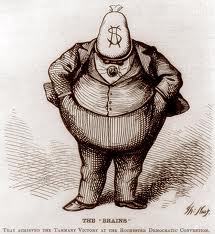
Thomas Nast, “Boss Tweed”
Links for today’s class:
William Grimes, “Your Tired, Your Poor, and Their Food,” New York Times 8/26/2010
Two videos for our consideration today:
Super Bowl XLV “The Journey” (pirated; hopefully the link will stay live today)
SchoolhouseRock, “Great American Melting Pot“
Click on any marker to see a short explanation of a Gilded-Age labor uprising, strike, or riot.
Gilded Age Industrial Conflicts on Google Maps
View Gilded Age Industrial Conflict in a larger map
 WE WILL HAVE CLASS ON FRIDAY Feb 4th because I will be in town, so we will hold "Wednesday’s class" on Friday. That way we still get our two class meetings in. We will discuss Chapter 19, “New Industrial Order.” Part of the class will be hands-on research, so please BRING YOUR LAPTOP if you can. I will collect the third Document Duel in class, and will hand back your papers from last week.
Thanks for your patience during this blizzard-a-week season! –Prof. Hangen
 Hello all,
I know that many students are impacted by the snowstorm and by the campus’s loss of electrical power. Some students have gone home or are staying with friends and don’t have their usual access to course materials, computers, etc.
This means that I am not going to be a Grinch about the 9:30 Friday morning deadline for this week’s Document Duel. If you intend to turn one in, write it and get it to me when you can, whether that’s a few hours late or a few days late. Don’t panic. Just proceed at whatever pace you can given your personal circumstances.
See you tomorrow (I hope!) –Prof. Hangen
Outlet image via Sixth Lie, used by Creative Commons license
I’m giving you a heads-up that I will be out of town the end of next week for a conference, so we will not have class on Friday, Feb 4th. Document Duels will still be due; you can upload them before 9:30 am to Digital Dropbox, turn them in on Wednesday Feb 2 in class, or drop them Thursday or Friday in my office mailbox in Sullivan 327-B.
Every Friday, I will post a PowerPoint highlighting the week’s in-class slides, to help you review and improve your class notes. Those will also be archived on a new course webpage called “Slides” starting this Friday 1/28. I’ll still post one next Friday even though we won’t have class. And we will keep to the reading schedule as outlined in the syllabus, although it means we only have one day to discuss Chapter 19 (Wed 2/2).
If you wrote a Document Duel for last week, I have graded them and will hand them back tomorrow. However, to help you in writing your second paper, I’ll be emailing each of you my comments so you know how you did before you finish writing DD#2.
Finally, I have posted an example of a strongly-written Document Duel, for those of you who would like to have a model to work from. Yours does not have to look like this one, but sometimes students benefit from seeing what a good paper looks like. It will also be on the updated Document Duel page; click the tab above.
WSU is closed due to the snowstorm. That raises 2 issues: what to do about the Document Duel due today, and what to do about the material we were to have covered in class.
Document Duel: submit by uploading it to Digital Dropbox. If you upload it, I’ll bounce back a quick “I got it” email so you know it was received. I will also accept hard copy (printed) in class on Monday.
Reconstruction: Our discussion today would have re-capped the Reconstruction era, a quick overview that would prepare us to understand what the economic, political and social conditions were in the late 1870s.
Since we can’t conduct that discussion in person, I still would like to give you the opportunity to reflect and synthesize. I created a Word document worksheet for you to complete. Upload it to Digital Dropbox when you are done, and that will count as attending class today even though we are officially closed (i.e. bonus). The Word doc has detailed instructions for how to complete and submit the assignment. This assignment is not required, since the university is closed and not everyone will have a functional internet connection. But I do recommend doing it if you’d done the preparation for today, so that you stay up to schedule with the course material.
We will keep to the syllabus as it’s written, so that means your reading for Monday is the first part of Chapter 18 (up to p. 480), “The New South” (Ask yourself: What was new about it? What wasn’t new?).
One last note: I heard from at least one student that the Experience History textbook is sold out in the University bookstore. While it’s not nearly as complete as the textbook, there is a free online American History textbook created by DigitalHistory.uh.edu at the University of Houston. You could substitute it for the printed textbook while you’re waiting for the order to arrive. It would also be fine to use a statement from that online textbook as the basis for your Document Duel in place of the EH text.
Digital History: Reconstruction
Digital History: The New South
© 2026 US History II | Powered by WordPress | NaturesHighlight Theme by ET | Header photo adapted from Keith Major

US History II (Worcester State University, HI 112) by Tona Hangen is licensed under a Creative Commons Attribution-Noncommercial-Share Alike 3.0 United States License.